Hotels in Suriname
1 cities · 3 hotels
Photo by Anoeskha B on Unsplash
Suriname: South America's Dutch-Speaking Rainforest Republic
Suriname sits on the northeastern Atlantic coast of South America, bordered by Guyana to the west, Brazil to the south, and French Guiana to the east. At roughly 163,820 km², it is the smallest sovereign state on the continent, yet holds one of the highest proportions of intact tropical rainforest globally — over 90% of its land area remains forested. The capital, Paramaribo, stands on the Suriname River and earned UNESCO World Heritage status in 2002 for its colonial inner city, a rare blend of 17th-century Dutch brick architecture and tropical timber construction.
Cities Worth Exploring
Paramaribo anchors the country's hotel supply and cultural life. The Waterkant (waterfront boulevard), Neveh Shalom synagogue — dating to 1736 and standing metres from a mosque — and the Fort Zeelandia complex on the riverbank give the capital a texture unlike any other South American city. Around 350,000 of Suriname's 620,000 residents live in greater Paramaribo, making it the clear urban centre for accommodation and onward travel logistics.
Nieuw Nickerie, the country's second-largest town near the Guyanese border, serves as a base for the Bigi Pan wetlands, a Ramsar-listed area of mangroves and waterways where scarlet ibis nest alongside caiman. The drive west from Paramaribo along the coastal highway covers roughly 230 km.
The Interior: Rainforest and River Communities
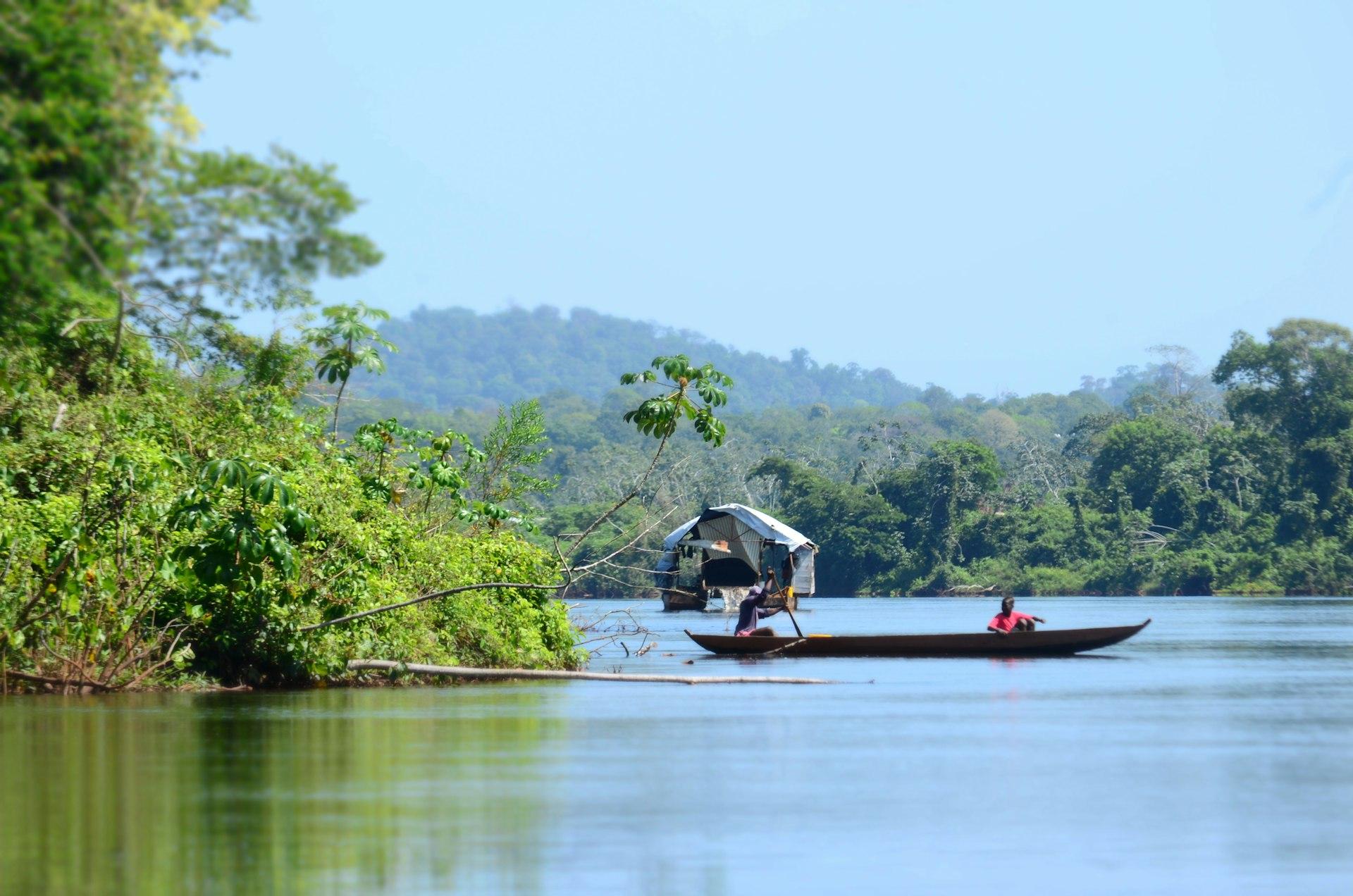
The vast southern interior is divided into protected zones including Central Suriname Nature Reserve, a UNESCO site covering 1.6 million hectares designated in 2000. Access routes follow the Suriname, Saramacca, and Cottica rivers by dugout canoe or small motorboat. Villages of the Saramaka and Ndyuka Maroon communities — descendants of escaped enslaved Africans who established autonomous societies in the 17th and 18th centuries — offer cultural homestays along the Upper Suriname River corridor near Atjoni and Awarradam. Suriname's interior lodges are small-scale and book quickly; advance reservation is practical during the dry season.
When to Visit Suriname
Suriname has two dry seasons: the long dry season runs February through April, and the short dry season from August through November. The long rainy season (May–July) and short rainy season (December–January) raise river levels, which can both complicate overland access and — for experienced travelers — improve wildlife sighting conditions in flooded forest margins. Temperatures in Paramaribo average 27–29 °C year-round; the interior runs warmer with higher humidity.
Practical Tips for Visiting Suriname
- Currency: The Surinamese dollar (SRD) is the local currency; USD and EUR are accepted at larger hotels in Paramaribo.
- Language: Dutch is the official language; Sranan Tongo (an English-based creole) functions as a widely spoken lingua franca across all communities.
- Getting around: No passenger rail exists; domestic flights operated from Johan Adolf Pengel International Airport (26 km south of Paramaribo) connect to Nickerie and Stoelmanseiland for interior access.
- Visas: Citizens of many countries require a tourist card (e-Visa) obtained online before arrival; check the Surinamese Ministry of Foreign Affairs portal for current eligibility.
- Yellow fever: A valid yellow fever vaccination certificate is required for entry when arriving from certain countries — carry the physical card.
Frequently Asked Questions
Q: What is the best base for exploring Suriname? A: Paramaribo is the practical base for all travelers. The city holds the majority of hotels, international flight connections, and tour operators offering river and rainforest trips into the interior.
Q: How do travelers reach the rainforest interior from Paramaribo? A: Most routes begin with a road transfer to Atjoni (roughly 4–5 hours by car), followed by a motorized canoe along the Upper Suriname River. Some interior lodges offer light aircraft transfers from Paramaribo's domestic airstrip.
Q: What currency and language are used in Suriname? A: The Surinamese dollar (SRD) is the official currency. Dutch is the formal language, but Sranan Tongo is spoken widely; English is understood in most hotels and tour operations in Paramaribo.
Q: Is Suriname suitable for first-time South America travelers? A: The capital and coastal towns are straightforward to navigate. The interior requires guided logistics and physical preparation — river travel, humidity, and limited infrastructure demand planning that differs significantly from backpacker-friendly neighboring countries.
Q: When is the quietest hotel season in Paramaribo? A: The long rainy season (May through July) sees reduced visitor numbers, which typically corresponds to lower hotel rates in Paramaribo. The February–April dry season is the peak travel window.